










Driving Growth for Mid-Market & Enterprise Ecommerce Brands



Clients
BenEfits
Capture buyers the moment they ask ChatGPT, Gemini or Google's AI Overview for a recommendation.
Show up inside AI answers and comparison prompts, not just the blue links beneath them.
Build the authority that keeps you visible on high-intent searches across Google and AI platforms.
Every visibility gain from your AI SEO services ties back to leads, pipeline and revenue.
Acquire customers through visibility that compounds, without raising ad spend every quarter to hold volume.
Answer the real question and earn stronger trust signals, longer sessions and more conversions.
Case studies
Objective
To dominate Black Friday organic search by doubling sessions and revenue while securing a top-three Google ranking for “Black Friday.”
Challenges
– Extremely high competition for the “Black Friday” keyword
– Low visibility in rich results and featured snippets
Solutions
– Built research-led Black Friday content optimized for Featured Snippets and FAQs
– Strengthened internal linking and crawl priority through smart URL targeting
Results
increase in organic Black Friday revenue
Objective
To scale organic visibility globally, drive high-quality leads, and accelerate user acquisition across key international markets.
Challenges
– Duplicate content impacting indexing and rankings
– Poor site architecture limiting crawlability
– Declining search demand for core social media keywords
Solutions
– Built a geo-focused SEO framework with region-specific microsites
– Implemented hreflang, technical SEO fixes, and intent-led content optimization
– Launched a knowledge hub to capture top-of-funnel global demand
Results
increase in organic users across global markets
Objective
To expand visibility beyond traditional SEO by establishing strong discoverability across AI-led platforms like ChatGPT, Gemini, Perplexity, and Google AI Overviews across MENA markets.
Challenges
– Shallow, transactional content limiting AI authority signals
– Weak schema, internal linking, and entity-based structure
– Fragmented content not aligned with regional or multilingual intent
Solutions
– Built entity-driven content hubs and AI-optimized category pages
– Implemented semantic clustering and conversational query optimization
– Strengthened technical SEO for AI readability and faster indexing
Results
Objective
To increase qualified organic leads, improve conversion rates, and significantly reduce organic cost per lead across desktop and mobile.
Challenges
– High organic CPL with low conversion efficiency
– UX, technical, and intent misalignment across high-traffic pages
Solutions
– Implemented user-first CRO with intent-driven SEO and refined lead qualification
– Fixed technical gaps and optimized UI/UX using behavioral and analytics insights
Results
Objective
To improve conversion efficiency by turning existing website traffic into qualified insurance leads through focused CRO and UX enhancements.
Challenges
– Low session-to-conversion ratio despite strong organic traffic
– User friction across key pages impacting inquiry submissions
– Ineffective CTA visibility during critical decision moments
Solutions
– Conducted a detailed CRO audit to identify and fix friction points
– Improved UI and on-site user flow to reduce drop-offs
– Placed intent-driven CTAs across high-impact insurance pages
Results
Improvement in Conversion Rate on AMP (Accelerated Mobile Pages)
Objective
To increase app store keyword visibility, drive high-intent non-branded traffic, and improve app performance across the Play Store and App Store.
Challenges
– Intense competition from established financial apps
– Low visibility for high-intent, non-branded keywords
Solutions
– Executed a full-funnel ASO strategy covering keywords, visuals, reviews, and UX
– Improved app stability and metadata via Android Vitals
Results
Challenges
You don’t rank on LLMs the way you rank on Google. There is no position one. These systems pull from sources they judge credible, so visibility comes from topical depth, clear entity signals and repeated citations. The first job is mapping which of those you’re missing before touching anything else.
Standard rank reports won’t show it. You track brand mentions, citations, referral traffic from AI tools, branded search lift, and how often you appear for the prompts your buyers type. Prompt-level testing gives you the baseline. Learn How to Measure AIO to track AI visibility, prompt performance, and the impact of your optimization efforts more effectively.
ChatGPT, Gemini, Claude, Perplexity, Microsoft Copilot and Google AI Overviews cover most of it. Each pulls from different sources, so appearing on one guarantees nothing on another. Good AI SEO services check every platform separately.
Answer the question in the first two sentences, then support it. AI Overviews favor content that is easy to lift clear structure, schema markup, topical depth, and a direct response near the top. Padded introductions get skipped.
Usually one of four things: thin authority signals, unclear entity information, content that buries the answer, or gaps in topical coverage. AI systems cite what they understand and trust. An AI SEO company starts with a visibility audit to find which one is costing you.
Get referenced by sources the models already trust: credible backlinks, digital PR, expert commentary, reviews, and consistent brand information everywhere you appear. Third-party validation makes a citation likely. Your own site rarely does it alone.
Write for questions, not keywords. AI search matches conversational intent, so content needs direct answers, semantic depth, structured formatting, and enough specificity to be worth quoting. AI SEO services fix the format as much as the substance.
Search is moving from links to answers, and it will keep moving. Staying visible means monthly prompt testing, refreshed content, and watching who gets cited in your place. Smaller brands can start narrow. SEO for Small Business Service applies the same principles at a workable scale.
Process
You start by finding out where you stand. Organic rankings first, then the harder questions: does your brand appear in Google AI Overviews, do ChatGPT and Perplexity mention you when someone asks about your category, and which competitors get cited in your place?
From there it moves into the technical layer crawlability, indexation, rendering, page speed, anything stopping AI crawlers from reading your site. Your content gets mapped against the questions buyers actually ask, so gaps become visible rather than assumed. Entity signals get checked too: whether your brand, products and people are described consistently enough for a model to recognize them.
What you get is a baseline for the whole AI SEO strategy not a checklist, but a clear picture of where visibility is leaking, which fixes move fastest, and what the realistic ceiling looks like in your category. Findings come back ranked by effort against likely impact, so the first month of work is decided before it starts rather than negotiated later. Our SEO audit service covers the traditional side in more depth.
Keywords alone won’t tell you where AI visibility is won. This stage maps the question space around your category — the prompts people type into ChatGPT, the comparison searches, the “best tool for X” queries, the commercial questions that come just before a purchase, and the topics shaping how models understand your space.
Each gets tied back to entities: your brand, your products, the people behind them, and the topics you can credibly own. Ambiguity is why brands get skipped, so the goal is an unambiguous picture of who you are. This is the part of AI search engine optimization no keyword tool will do for you.
You end up with a map of every place your brand can influence an AI answer, ranked by commercial value rather than search volume alone. A prompt asked fifty times a month by buyers comparing vendors is worth more than one asked five thousand times by students. That map then drives what gets written, what gets restructured, and what gets left alone.
Most pages fail in AI search for a boring reason. The answer is buried three scrolls down, underneath a warm-up paragraph nobody asked for.
Existing content gets rewritten so the direct answer sits in the first two or three sentences, with supporting detail underneath. Long pages get short summaries. Buyer questions become proper FAQ blocks. Where a comparison makes the decision easier, it becomes a table instead of three paragraphs. Statistics, examples and named specifics get added, because models quote concrete content far more readily than general content.
Every section closes with a clear next step, so visibility has somewhere to go rather than ending in a dead scroll.
Nothing here means writing for machines at the reader’s expense. The same changes that make a passage easy for a model to lift — a clear answer up front, specifics instead of adjectives, sensible subheadings — are the changes that make it easier for a person in a hurry. The result works twice over: readable for the human, extractable for the machine. This is where a structured content marketing service earns its keep, making the rewrite repeatable across hundreds of pages rather than a dozen.
Structure is what lets a machine read your site with confidence. It’s the least glamorous part of AI SEO services and the one that most often unblocks everything else through technical seo service.
Schema markup goes in first — Organization, Service, FAQPage, Article, Product and Breadcrumb, depending on the page — so search engines and AI systems identify what each page covers without guessing. Author and entity markup connects content to verifiable expertise.
Then comes access. Crawlers such as GPTBot, PerplexityBot, ClaudeBot and Google-Extended need permission and a clean path through your robots.txt, and an llms.txt file gives them a plain-text guide to your key pages. Rendering matters too, since content locked behind JavaScript often never gets read.
The rest is fundamentals that still count: Core Web Vitals, mobile usability, internal linking, canonical hygiene, XML sitemaps. None of it is new, and all of it still decides whether your best content is reachable. Get this layer right and everything you publish afterwards has a better chance of being found and cited.
AI systems recommend brands that other credible sources already vouch for. Self-description counts for very little. This stage earns you the outside validation that does count.
It runs on several tracks at once. Editorial backlinks from publications in your industry. Digital PR that puts your data or point of view in front of journalists. Expert-led content carrying a real name and real credentials. Reviews on the platforms your buyers check before they shortlist anyone. Consistent citations, with your business name, address and details matching everywhere they appear, because inconsistency makes a model less certain it is describing the same company.
None of this works as a one-month push. Trust signals accumulate, and models weight sources that have been referenced consistently over time rather than all at once. A burst of low-quality placements can actively work against you. Our link building services focus on quality over volume for that reason — ten mentions from publications your buyers already read will do more than a hundred from sites nobody checks.
AI answers are unstable in a way rankings never were. The same prompt can return a different set of brands one month to the next, so visibility that isn’t monitored quietly decays.
Every month, a defined set of prompts gets tested across ChatGPT, Gemini, Perplexity, Copilot and AI Overviews to see where you appear, where you don’t, and who took your place. Rankings, traffic and conversions get tracked alongside, so AI visibility is never reported in isolation from revenue.
What that surfaces feeds straight back in. Pages that slipped get refreshed. New questions get answered before competitors reach them. Brands that gained citations at your expense get examined for what they did differently, since the answer is usually specific and copyable. You see the same numbers we do, in a report that says what changed, what caused it, and what happens next — not a dashboard you have to interpret alone.
Testimonials
Why Us?

AI visibility runs on signals most tools don’t track. Infigrowth, our proprietary platform, monitors them across search engines and AI surfaces — which prompts you appear for, which competitors get cited, where the gaps sit. It’s the difference between guessing and measuring.

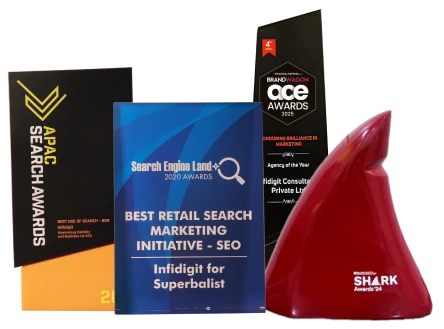
Eighty-plus industry awards, including Search Engine Land and ANA International ECHO recognition, sit behind the approach you’d be buying. Every AI SEO strategy pairs proven fundamentals with newer optimization techniques, because authority and trust still decide who gets cited. The surfaces changed; the logic didn’t.

Effective AI SEO services need technical SEO, content strategy, data science, digital PR and structured-data expertise working together. You get 150+ specialists across those disciplines instead of one generalist stretched thin, which is why analysis goes deeper and implementation actually ships.

Finding the right opportunity before a competitor does is most of the advantage there is to have. Automation handles volume, analytics handles pattern-finding, and strategists decide what’s worth doing. Your budget goes where it moves visibility, not where it looks busy.

You’ll always know what’s being optimized, why it matters, and what it should change. Reporting is plain-language and tied to your business goals — no jargon walls, no surprise scope, no waiting a quarter to find out whether it worked.
Plans
Startups Business
Your Growth Toolkit
Small-Market Businesses, Competitive Niches
Your Growth Toolkit
Mid-Market Businesses, Competitive Niches
Your Growth Toolkit
Enterprise, Large E-commerce, Site Migrations
Your Growth Toolkit
Industry
Platforms


Solutions
Drive sustainable traffic and revenue growth
Optimize visibility across AI search engines
Future-proof search strategy with AI
Scale product visibility and online revenue
Turn visitors into measurable revenue growth
Increase app visibility and install growth
Dominate local search and nearby customers
Authoritative backlinks that boost search rankings
Scalable SEO solutions for large organizations
Build websites that improve engagement
Find and fix issues affecting search visibility
Drive organic growth with strategic content

Growth Manager - Superbalist
SEo Growth
These five terms get used interchangeably, often by people selling them, which makes buying decisions harder than they need to be. They are not competing products. Each describes a different layer of visibility, and the layers stack. Knowing which one you are actually short on is what stops you paying twice for the same work.
The plainest way to separate them is by what each one is trying to win.
Traditional SEO wants a position. It competes for a place on a results page, and rankings are the scoreboard. That work has not stopped mattering, because most AI systems still draw heavily on pages that already rank well.
GEO service wants a citation. Generative engine optimization is concerned with whether an AI names your brand when it composes an answer, which depends far more on external credibility than on where you sit in a results list.
AEO service wants the answer slot. Answer engine optimization is a formatting and structuring discipline — shaping content so it can be lifted cleanly into featured snippets, People Also Ask boxes, voice results and AI Overviews.
LLM SEO service wants presence inside the models themselves, across ChatGPT, Claude, Gemini, Perplexity and Copilot, each of which sources and retrieves information differently.
Run in isolation, each of these has a ceiling. Perfect formatting cannot rescue a brand nobody credible references. Strong citations do not help if AI crawlers cannot read your pages. AI SEO brings all these layers together into one search visibility strategy, sequencing them so the foundational work happens before the work that depends on it. That is why AI SEO sits above the others rather than beside them, and why any provider should be able to tell you which layer you are missing before it sells you anything.
Our SEO service covers the organic foundation this rests on, and CRO service turns the visibility you gain into conversions.
AI tools



Growth Manager - Superbalist
Locations
FAQ’s
AI SEO is the practice of making your brand visible inside AI-powered search — Google AI Overviews, ChatGPT, Gemini, Perplexity, Copilot and similar tools. Traditional SEO aims at a position on a results page. AI SEO aims at being the source a model draws on when it writes the answer. That means clear entity signals, deep topical coverage, structured data, extractable formatting, and enough third-party credibility that AI systems treat you as worth citing. Most AI SEO services bundle these into one program rather than selling them piece by piece.
GEO, or generative engine optimization, is one part of AI SEO rather than a synonym for it. GEO focuses on getting cited, mentioned and recommended inside generative AI answers. AI SEO is the umbrella above it, covering GEO alongside answer engine optimization, LLM visibility, and the organic foundation they rest on. Do only GEO and you’re optimizing a single surface. AI SEO holds the strategy together across all of them.
Traditional SEO competes for a position on a results page. AI SEO competes to be the source behind an answer. Less weight on keyword placement, more on entity clarity, semantic depth, structured data and credibility. Rankings still matter, but they are no longer the only measure.
Most brands see early movement within three to six months: a first citation, a mention in an AI Overview, a lift in branded search. Durable authority gains take six to twelve months. Anyone promising faster is guessing.
Yes, and often more so. Smaller brands win AI visibility on specific, well-defined questions where larger competitors published something generic. Narrow topical depth beats broad shallow coverage in AI answers, giving a focused business a route into results it would struggle to reach otherwise.
Ask what they measure. A capable provider shows you prompt-level visibility data, entity optimization work, technical implementation, and how AI presence connects to leads — not just a rankings dashboard. Ask for citations they have earned. Vague answers are the warning sign.
It is the work of making your content easy for Google’s AI to lift and reference: answering the question directly near the top of the page, supporting it with specifics, adding relevant schema, and building enough topical authority that Google treats you as a credible source.
ChatGPT, Gemini, Claude, Perplexity, Microsoft Copilot, Google AI Overviews and AI Mode cover most AI-driven discovery today. Which matter most depends on your audience, since B2B buyers behave differently from consumers. Optimization starts with prompt testing to find where your customers already are.
Large brands have more surface area to get wrong. Thousands of pages, multiple product lines and long buying cycles mean AI systems can easily misrepresent you or skip you. AI Search Optimization services keep your business described consistently at scale and protect visibility across every discovery platform your buyers use.