










Home > Industries > SEO for SaaS Companies
SaaS SEO services that meet software buyers where they actually search, and turn that traffic into trials and demos.

Driving Growth for Mid-Market & Enterprise Ecommerce Brands



Clients
Know The Basics
SaaS SEO services help software companies capture prospects who are searching for solutions, specific features, or competitor alternatives rather than brand names. Because the software buying cycle is research-heavy, a specialized SEO agency builds tailored content mapped to how buyers evaluate software. This involves structuring product pages around specific features, comparison pages for “X vs Y” queries, platform integration hubs, and problem-first guides for buyers who have not named a category yet.
When executed well, SaaS SEO service transforms organic search into a high-converting pipeline that consistently generates free trials, demo requests, and qualified leads.
BenEfits
SEO for SaaS companies captures searches for product categories, alternatives, comparisons, and integrations directly.
Trial and pricing pages get built around what actually converts visitors, not just what ranks.
Better keyword targeting means the traffic you get is more likely to convert.
Builds durable organic demand, easing reliance on paid search and paid social spend.
Even as paid costs climb, SaaS SEO services keep generating leads long after campaigns end.
Whether you’re PLG, freemium, demo-led, or enterprise sales, organic search adapts to your go-to-market.
Process
Every engagement starts with a full audit of the current site, not a generic checklist, but a review built around SaaS-specific signals: technical SEO health such as crawlability, indexation, site speed, and mobile rendering, product and pricing pages checked for conversion friction, and content gaps mapped against what competitors already rank for.
The audit also pulls in analytics and CRM data, connecting organic sessions to actual trial signups, demo bookings, and closed revenue where tracking allows. This matters more for SaaS than most industries, since a page that ranks well but never converts is effectively invisible to the business, despite looking healthy in a rankings report.
Where the audit uncovers deeper structural issues, such as outdated page templates, broken conversion paths, or a site architecture that cannot scale with new product lines, those findings sometimes point toward a broader website design service engagement rather than a content fix alone. As part of a thorough SEO audit service, the output is a prioritized backlog: what to fix first, what to fix next, and what can wait, ranked by expected impact on pipeline rather than by convenience.
SaaS buyers rarely search the way a keyword tool suggests. A VP of Sales, an IT admin evaluating security requirements, and a solo founder testing free tools all type different queries for what might be the same underlying need. This step, core to any thorough SaaS SEO service, builds out ideal customer profiles and buyer personas, then maps how each one searches at each stage of decision-making.
Pain-point language matters here more than product terminology. A prospect struggling with team visibility might search “why is my remote team missing deadlines” long before they search anything resembling a product category name. Capturing that earlier-stage language is often what separates a SaaS SEO strategy that only ranks from one that actually builds pipeline.
The mapping also accounts for how B2B SaaS buying groups behave, with multiple stakeholders researching independently, often across weeks or months, before converging on a shortlist. Content gets built to serve each of those research moments, not just the final comparison search that happens right before a demo request. This groundwork shapes every keyword and content decision that follows in the process.
With intent mapping complete, keywords get organized by where they sit in the buying journey rather than by search volume alone. Someone at the awareness stage is grappling with a problem and doesn’t yet know software could solve it. By the time they’re comparing pricing, alternatives, and integrations, they’re usually one click from a demo request.
It’s a mistake we see constantly: chasing big, top-of-funnel keywords that pull in traffic but rarely convert, while overlooking smaller, high-intent searches like “[competitor] alternative” that close at a far better rate. Generic agencies tend to miss this distinction entirely. An SEO agency for SaaS companies specifically doesn’t.
Competitor and alternative keywords get particular attention, since SaaS buyers compare options aggressively before committing. Integration searches, such as “[product] plus Salesforce integration,” get mapped separately too, since they signal a buyer who already understands the category and just needs confirmation the tool fits their stack. The result is a keyword architecture tied to funnel stage, not a flat list ranked by volume, the foundation solid SaaS SEO services are built on.
Generic SEO advice rarely accounts for what makes SaaS sites technically different. Many run on JavaScript-heavy frameworks that render content client-side, and that can trip up search engines trying to crawl and index pages the way they would a static site. So this step checks rendering behavior directly: are product pages, pricing pages, and blog posts actually indexable, or just visible to a human looking at a browser?
Site speed gets particular attention here. SaaS landing pages often carry extra weight: chat widgets, analytics scripts, interactive demo embeds, and it can quietly tank Core Web Vitals scores without anyone noticing until traffic dips. Structured data comes next: software application schema, FAQ schema, review schema, whatever applies, so search engines and AI systems know exactly what the page offers.
Internal linking, redirects, and canonical tags round out this layer. It matters more for SaaS than people expect, since product pages get launched, renamed, and retired constantly as the roadmap shifts. Ignore this, and you end up with redirect chains and duplicate content quietly dragging rankings down, usually with no clear warning sign until the traffic numbers already look wrong.
Existing content gets rebuilt around what buyers actually need at each stage. The pages carrying the most commercial weight- homepage, core product pages, pricing- go first. Too often these pages try to speak to every visitor at once, and end up speaking clearly to none of them. Sharper messaging around specific use cases fixes that.
Feature and integration pages come next. Done right, these tend to rank well for very specific, high-intent searches, think “[product] Slack integration” or “[product] for remote teams.” The same logic applies to comparison and alternative pages: they catch searches happening right before a purchase decision, and honest, specific positioning simply outperforms vague marketing copy.
Blog content fits into this same structure instead of running as its own separate channel, feeding the funnel stages the keyword mapping already identified rather than churning out disconnected posts for volume’s sake. This is where content marketing and SEO genuinely overlap: every page and article gets built to serve search intent first, and lead generation follows as a natural outcome rather than something bolted on after the fact.
Software buyers increasingly start their research inside AI tools rather than a traditional search bar, asking ChatGPT or Perplexity to compare categories or recommend a shortlist before ever visiting a vendor’s site. This step optimizes SaaS content specifically for that behavior, structuring pages so AI systems can extract and cite them accurately.
Entity clarity matters a lot here, ensuring search engines and language models understand exactly what the product does, who it competes with, and what problems it solves, rather than leaving that inference to chance. Comparison-style content gets restructured to answer the exact prompts buyers use in AI tools, since “[product] vs [competitor]” performs very differently as an AI-optimized answer than as a traditional blog post.
This work sits alongside, not instead of, an AI SEO service approach that also covers Google’s AI Overviews and answer-engine visibility, since an LLM SEO service engagement and traditional AI Overview optimization now require overlapping technical and content work. Clear definitions, structured answers, and genuinely citation-worthy data all get prioritized here, because AI systems consistently pick original, specific information over generic marketing copy when deciding what to surface.
Link building still matters for SEO services for SaaS, but where those links come from matters more than how many you get. SaaS-relevant directories, integration partner pages, and platforms like G2 and Capterra carry weight here, since a strong presence shapes both rankings and buyer trust right when it counts: during the comparison stage.
Partner and integration links carry particular value. A mention on a partner’s integration page reaches an audience that’s already evaluating relevant tools, which is about as warm as referral traffic gets. Original research, benchmark reports, and usage statistics earn links too, and for a simple reason: journalists and other SaaS sites would rather cite a specific number than repeat a generic claim.
Thought leadership rounds out the strategy: expert commentary and bylined content placed on the publications your buyers are already reading. This is slower than volume-based link building, but it builds the kind of durable authority that search engines and AI systems increasingly reward, particularly as citation-worthiness becomes a bigger ranking factor across both traditional search and AI-driven discovery platforms, exactly where strong SaaS SEO services now have to compete.
Reporting for SaaS SEO services tracks the metrics that actually matter to a SaaS business, not just rankings and traffic in isolation. Keyword positions and organic sessions still get reported, but sit alongside trial signups, demo requests, and, where CRM integration allows, the downstream MQLs, SQLs, and pipeline those sessions eventually produce.
This connection between organic activity and revenue is what separates SaaS SEO reporting from a standard traffic dashboard. A page pulling strong traffic but generating zero trial signups gets flagged for optimization. A lower-traffic page that converts well gets more investment instead, even though its raw numbers look modest next to the traffic leaders.
Technical backlog progress gets tracked right alongside content performance too, mostly because technical fixes can take weeks before their impact actually shows up in rankings. Reports include what shipped, what is pending, and what is next, giving stakeholders visibility into the work itself rather than just the outcomes. Where results tie back to MRR influence or pipeline contribution, that connection gets surfaced explicitly, since it is usually the number that matters most in a boardroom conversation about whether organic search is working.
Testimonials
Why Us?


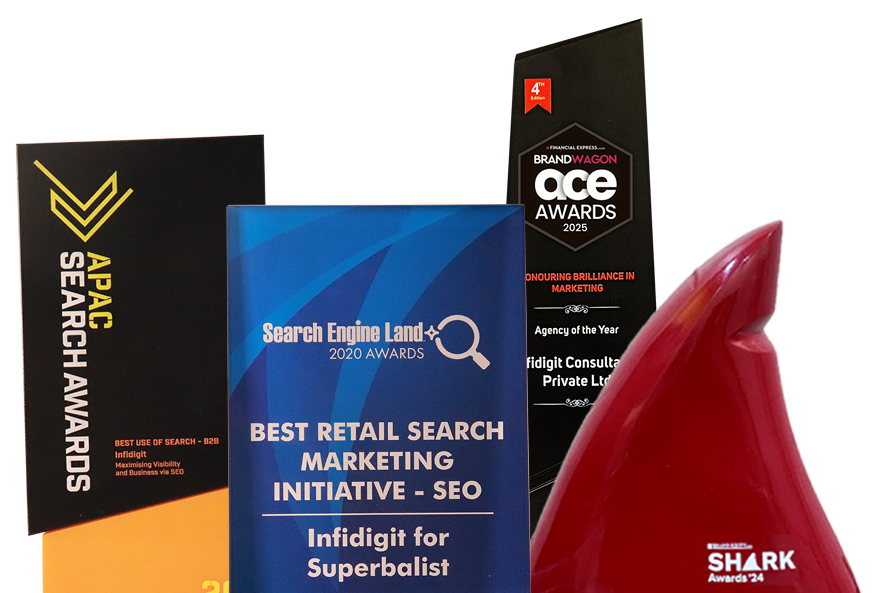
Infidigit has won 100-plus industry awards, including recognition from SMX, the APAC Search Awards, and the ET BrandEquity Shark Awards, honors judged on measurable client outcomes, not submissions alone. For a SaaS company evaluating agency partners, that track record signals proven execution across genuinely competitive, scrutinized SEO work.

130-plus specialists work across technical SEO, content strategy, and AI search, and every account gets its own dedicated project manager rather than a shared inbox. That kind of depth means faster execution for software companies, and an SEO company for SaaS that can actually keep pace as products launch and roadmaps shift.

Results tie directly to business outcomes: organic sessions, non-brand clicks, revenue growth, rather than vanity metrics floating disconnected from pipeline. ICICI Prudential and Dun & Bradstreet have both seen multi-fold jumps in AI-driven traffic and organic leads working with Infidigit, real proof that visibility here consistently turns into measurable growth.

Reporting ties rankings and traffic straight back to trials, demos, and MQLs, so stakeholders get a clear, CMO-level view of what SEO is actually producing, not a vague approximation. No black-box dashboards or vague monthly summaries, just SaaS SEO services reported the way a revenue-focused software business actually needs to see them.
Plans
Startups Business
Your Growth Toolkit
Small-Market Businesses, Competitive Niches
Your Growth Toolkit
Mid-Market Businesses, Competitive Niches
Your Growth Toolkit
Enterprise, Large E-commerce, Site Migrations
Your Growth Toolkit
Industry
Solutions
Drive sustainable traffic and revenue growth
Optimize visibility across AI search engines
Future-proof search strategy with AI
Scale product visibility and online revenue
Turn visitors into measurable revenue growth
Increase app visibility and install growth
Dominate local search and nearby customers
Authoritative backlinks that boost search rankings
Scalable SEO solutions for large organizations
Build websites that improve engagement
Find and fix issues affecting search visibility
Drive organic growth with strategic content
We’ve worked with Infidigit for several years and have consistently been impressed by their expertise, professionalism, and results-driven approach. Their team has played a key role in improving our organic visibility and helping us achieve sustained growth. From Jan’25 to Aug’25, organic clicks grew by 138% and impressions by 119%, reflecting the strong results of our ongoing SEO efforts. It’s been a pleasure partnering with them.

Growth Manager - Superbalist
Locations
FAQ’s
SEO in SaaS is the practice of optimizing a software company’s website so it ranks for the terms buyers actually search, including product features, use cases, comparisons, alternatives, and integration queries, rather than just brand or generic industry terms. SaaS SEO services differ from standard SEO because the buying journey is longer, more research-driven, and often involves multiple stakeholders evaluating a product independently before converging on a shortlist.
Where general SEO might focus on traffic volume alone, a proper strategy by an SEO for SaaS company is built around funnel stage: awareness content for buyers who have not identified a category yet, comparison content for buyers narrowing options, and conversion pages for those ready to request a demo or start a free trial. Done well, it becomes a durable pipeline source that compounds rather than resets every month like paid channels do.
SEO is crucial for SaaS companies because most software buyers now research extensively before ever speaking to a sales team, and organic search is where a large share of that research happens. Think about what “best tool for X” searches or “[competitor] alternative” queries actually represent: buyers actively evaluating their options. A strong organic presence catches those moments in a way paid ads simply can’t sustain cost-effectively, month after month.
There’s a cost angle too. SEO services for SaaS companies cut dependence on rising paid acquisition costs, because organic rankings keep generating trials and demo requests long after the ad spend that built them has stopped. And as paid search and paid social both get more expensive, a durable organic channel stops being a nice-to-have and starts looking like a structural requirement for growing efficiently in a crowded software market.
Start with the pages closest to a buying decision: product pages, feature pages, pricing, comparison and alternative pages, integration pages, and use-case content. These carry the highest commercial intent, which is exactly why they sit closest to a demo request or trial signup. The homepage matters too, but usually needs sharper positioning rather than broad messaging trying to speak to every visitor at once.
Blog content plays a supporting role, feeding awareness and consideration-stage searches that eventually lead buyers toward those higher-intent pages. Integration-specific pages deserve particular attention, since a prospect searching “[product] plus Salesforce integration” already understands the category and simply needs confirmation the tool fits their existing stack, making these some of the highest-converting pages a SaaS company can optimize as part of any serious SEO service engagement.
Yes, SaaS SEO services are specifically built to connect organic traffic with demo requests and free trial signups, not just to grow visitor counts. That happens through pairing high-intent keyword targeting with page design built for conversion, so anyone landing on a comparison or pricing page from organic search finds an obvious, low-friction way to start a trial or book a demo.
Comparison and alternative pages tend to perform particularly well here, mostly because visitors coming from those searches are usually close to deciding already. It’s also worth remembering that even perfectly targeted traffic converts poorly on a slow, cluttered page, so CTA placement, trust signals, and page speed all become part of the same conversion work.
Most SaaS companies see measurable movement within three to four months. Real demo and trial growth usually takes longer; six to twelve months is typical, and how fast depends on site authority, technical health, and just how crowded the category is. Quick-win content updates and technical fixes tend to show up first; authority and competitive keyword rankings take more time to mature.
Unlike paid campaigns, SaaS SEO services compound instead of resetting every month, so month twelve usually beats month three by a wide margin without spending another dollar. Just set expectations accordingly if you’re entering a crowded category like project management or CRM software; that runway will be longer than it would be in a narrower, less contested niche.