

Each and every marketing director i’m speaking to today is essentially asking the same question: “is this ai search stuff real, or is this just going to be the next ‘social seo’ which we’re going to forget about in 18 months?”
I totally get the skepticism. I’ve attended more than enough vendor presentations based on nothing more than a single screen shot of a ChatGPT answer to think that there are plenty of instances of “hype disguised as strategy.”
However, having spent the last 24 months completely overhauling how we serve our clients at Infidigit and watching how businesses perform when they ignore this trend vs. Those that embrace it, i truly believe that this is not hype. This is a fundamental transformation of how people find brands, and most marketing organizations aren’t even equipped to compete in this space yet.
This post is my attempt to provide simple definitions regarding what AIO actually means; why it needs to be a subject of discussion at the board level and not a footnote in your seo retainer; and what a responsible first-year budget would look like. I’m coming at this from the perspective of a practitioner, not a theoretician. Every time I refer to a number or a result, i’ll provide you with the exact details of where it comes from.
What is AIO & Why Should you Care About it More than SEO in 2026?
AI Optimization, also known as AI SEO, is defined as making a brand appear visibly, accurately representatively, and trustworthy within ai-generated answers as well as the answers provided by tools similar to ChatGPT, Gemini, perplexity and Google’s AI Overviews when users ask questions instead of entering a search query.
There isn’t agreement throughout the industry on what terminology to use for this discipline. In addition to AIO, GEO (generative engine optimization), aeo (Answer Engine Optimization) and LLMO (large language model optimization) are commonly referred to as synonymous in many vendor decks and blog posts. Since the distinction between each term matters for organizing how you approach the task, i want to be transparent about how i apply these terms.
- AIO (AI Optimization)
The parent discipline. The overall practice of making a brand visible, accurately represented, and trusted across every AI-mediated discovery surface — generative answers, direct-answer features, and future surfaces not yet named. - GEO (Generative Engine Optimization)
One channel within AIO. Optimizing specifically for citation inside generative answers from ChatGPT, Perplexity, and Gemini. - AEO (Answer Engine Optimization)
A second channel within AIO. Optimizing for direct-answer surfaces — AI Overviews, voice assistants, and featured snippets — that predate the generative AI wave but now overlap heavily with it. - LLMO (Large Language Model Optimization)
The infrastructure layer underneath GEO and AEO. Covers four sub-layers: crawlability and ingestion (can AI bots access and read your content), content retrievability (is your content structured so a clean, independent answer can be extracted), model trust and citation weighting (does your brand description corroborate consistently across independent sources), and structured data (schema markup that helps both search engines and LLMs parse your content accurately).
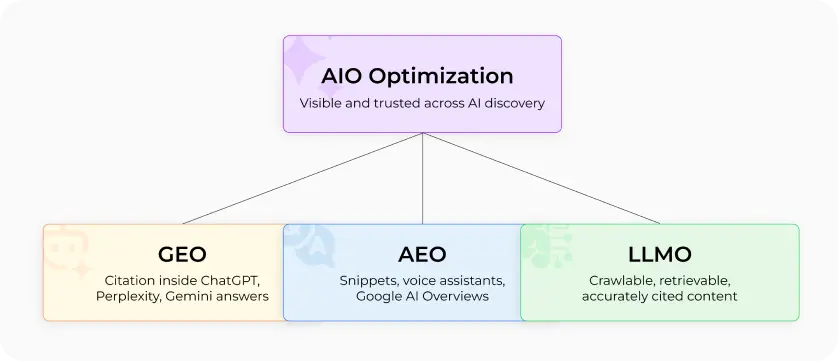
To clarify, the categorization of AIO as an overarching term with GEO as one component inside of it represents Infidigit’s selected framework — not an established industry-wide framework. If you contact another agency they may define these terms similarly or utilize them interchangeably. What ultimately matters is not establishing which party wins the debate surrounding semantics — it is that your organization establishes a unified internal definition so that no responsibility falls through the cracks between “our seo vendor” and “our new ai search vendor”. I plan on returning to why it is typically incorrect to divide these into two separate project management initiatives in a future article.
How Do AI-Powered Search Platforms Decide What to Surface?
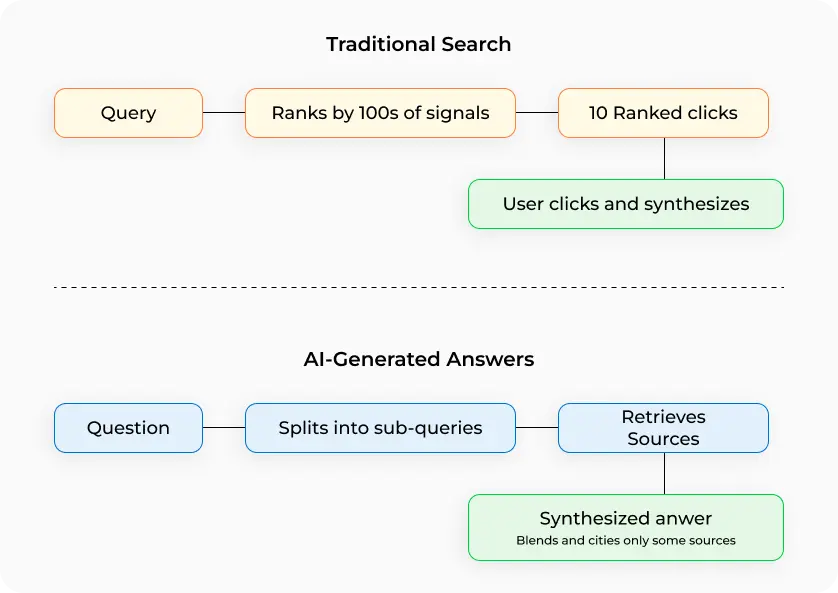
Search engine optimization (seo) ranking algorithms traditionally assess a web page against a query and weigh hundreds of factors (relevance, backlinks, page experience, recency) before displaying a ranked list of 10 blue links. Users perform their own evaluation by browsing through the displayed links and synthesizing their own answer.
Generative ai search tools operate differently. When users submit questions via ChatGPT or perplexity, the tools typically decompose the question into smaller sub-questions, retrieve candidate sources for each sub-question and generate a synthesized written response that integrates information from several sources — in their own words (not as excerpts).
The sources that are included in this synthesized written response are the ones that receive attribution in that response. All other sources — regardless of whether they rank well in traditional google search — are omitted from that response.
This is the area where CMOs who focus solely on measuring organic search rankings need to take notice. Being ranked #1 for your category and receiving no citation in an ai overview located immediately above that same result or receiving no citation in a ChatGPT response to a very similar question are possible.
From a practical standpoint, these systems seem to prefer sources that are: easily extractible into complete and uncorrupted self-contained answers; consistently described across independent sources outside of the brand’s own website; and devoid of vague marketing claims that cannot be quantifiably verified. Each of these areas will be discussed further in depth later in this article series, particularly in the article focused on writing content that receives citations from ai engines.
What Does AI-Driven Discovery Mean for a Brand’s Revenue?
Measuring the impact on Revenue caused by AI-Driven Discovery at an enterprise level is much more difficult than it sounds at marketing conferences. And i want to be upfront with you about that rather than give you a number i don’t feel confident standing behind. Multiple research firms/platforms have made available estimates of how much consumer/b2b purchasing decisions are influenced by ai-powered search/chat tools. While there isn’t absolute consensus amongst all of them regarding percentage points etc., the general directionality of all of them is consistent with regard to growth: increasing percentages of purchasing decision research are occurring within ai-driven conversations rather than traditional search results pages.
While i can offer insight into trends we’re seeing within our client base directly — since we track over 3.1 billion organic sessions and 39 million leads across over 135 documented case studies for our client base; we’ve begun segmenting our tracking of ai-referrals separately in client reporting — akin to how we previously segmented mobile traffic separately in client reporting approximately a decade prior. The practical significance lies in determining if your analytics stack currently provides you with visibility into what portion of your sessions are originating from an ai assistant versus traditional search methods; if it doesn’t you lack context for determining how significant this is for your specific business — therefore addressing this blind spot first prior to any broader statistics will help guide your strategic planning efforts.
Why Brand Spend, Not SEO Spend, Is the Right Budget to Shift to AIO
As i’m arguing frequently with CMOs in this vein, i believe the marketing community is approaching this topic incorrectly.
Most of the literature being developed around AIO frames this as a sub-budget allocation from your existing seo budget — i.e., allocate 15%-30% of what you currently invest in seo towards developing visibility in ai-based discovery. I believe this is an incorrect way to frame the mental model here because it treats AIO as a tactic competing for pieces of an insufficiently funded budget for solving this problem.
Consider what brand advertising/marketing dollars were purchased historically. They weren’t necessarily purchasing clicks. They were purchasing consideration: influencing the gradual development of familiarity for a brand name while a person considers solutions. That is literally what ai powered discovery accomplishes today except at the exact moment of intent with a much clearer path-to-measurement than was previously achievable with thirty seconds of tv ad exposure.
When CMOs accept this characterization, everything changes with respect to budget discussions. Rather than debating how large a fraction of an already-strained seo retainer can be allocated towards AIO, AIO becomes eligible for re-deployment from budgets dedicated to branding/awareness — budgets that are orders-of-magnitude larger than seo budgets whose roi has historically been challenging to measure. By comparison, AIO has measurable inputs: citation frequency, share of voice within ai-generated responses and conversions resulting from visits referred by ai-generated searches are all quantifiable in ways that billboards are not.
I’m not saying branding/advertising will cease to exist. I am stating that as buying behaviors continue trending toward ai-facilitated discovery, more incremental branding/advertising budget will belong in AIO vs. The same types of channels that created awareness for brands in a pre-ai search paradigm.
What Does AIO Actually Involve? The Four Work Streams Explained
Once a company allocates funding for this effort, the execution itself is comprised of four distinct project management streams. I find it helpful to explain each stream individually to CMOs because many vendors offering “AI SEO” services lump all four together under the same service offering description.
- Content authority: developing content structures/resources that allow a complete and un-corrupted self-contained answer to exist for the questions your buyers ask an ai assistant.
- Technical crawling: ensuring that your content can be accessed/read by ai crawlers (gptbot/ClaudeBot/PerplexityBot/etc.) — which is astonishingly common considering how many websites unintentionally prohibit crawling by these crawlers at either the CDN or robots.txt levels.
- Entity clarity: ensuring that your brand/product leaders are consistently described across your own website(s)/reviews/press/Wikipedia/analytics writeups/etc. That support corroboration of factual information about you.
- Offsite citation development: purposefully seeking out mentions/data presence on third-party sources that ai systems already value/credit rather than expecting your own website(s) will be sufficient.
Many agencies promoting “AI SEO” today are effectively only performing the first initiative listed above. The second and fourth initiatives outlined above create the differential in regards to whether a brand can receive consistent/intermittent citations.
How Do You Measure AIO Success as a CMO?
These performance metrics differ significantly from traditional seo reporting. And that is worth setting expectations on with your own executive leadership/board members prior to commencing work.
Citation rate: how frequently your brand appears as a citation when applicable category questions are submitted across ChatGPT/perplexity/Gemini/etc.
Share of model: your citation rate relative to named competitors across those same prompts measured over time rather than at a single snapshot.
The first point I made about how to measure if your AIO effort is working is to look at the number of conversions you get from traffic that came to you via an AI assistant, i.e., by way of being referred to your website or landing page by an AI assistant. This needs to be tracked and analyzed separately from Organic Search traffic in GA4. Once you have both of these metrics, then you can analyze them together and determine if there is a correlation. If you see an increase in traffic coming from organic search, but no corresponding increase in visitors who used an AI assistant, you will know that the use of an AI assistant didn’t help people find your site. On the other hand, if you see an increase in conversions that correlate with an increase in traffic from AI assistants, you will know that the AIO effort is producing tangible business results.
The second metric is Branded Search Lift. In other words, did the creation of new citations by an AI generate a correlating increase in searches using a specific phrase, i.e., your company name? Often times, branded searches are one of the best indicators of whether or not the AIO effort generated brand awareness and whether or not those interested parties searched online for a potential solution.
One thing that I’ve learned through experience is to avoid treating each individual prompt run as a singular event. Because AI systems rely on probabilities, not hard data, asking the same question multiple times may result in different responses. Therefore, to establish credible measurements regarding your AIO efforts, you should consistently send out a set of questions at regular intervals and track the resulting trends. Do not treat a snapshot view as indicative of long-term success.
What Results Can a Brand Realistically Expect From AIO in 12 Months?
In order to provide an objective assessment of what companies reasonably expect from their AIO initiatives, I’d like to draw upon actual examples of client work that I’ve done directly for companies. For example, when an airline client hired me to create an LLM SEO-focused strategy for their website, they saw a 350% increase in organic traffic as documented in my Airline Website LLM Strategy Case Study. The initial part of the project involved taking their existing content and structuring it into a form that would allow independent citation; after that was completed, technical changes were implemented to enable the crawling capabilities necessary for AI systems to locate the pages.
I also have several case studies of clients’ AIO results that I feel demonstrate some of the strongest evidence available to support what a company can achieve through disciplined AIO initiatives:
Flipkart Seller Hub LLM Strategy Case Study – 37x growth in LLM traffic (YOY)
DnB LLM Strategy Case Study – Over 1500+ AI Overview keyword placements and 57x growth in LLM platform traffic in under 3 months.
Based on what I’ve observed across various scopes of engagement and disciplines: Companies that commit to all four workstreams of AIO – including not only content development, but also improving crawlability and entity clarity on the website itself, as well as creating off-site citation opportunities – generally see significant increases in citation frequency within 2-4 months and compound growth thereafter as off-site authority signals build up. Conversely, companies that focus solely on content improvements without addressing crawlability and off-site citation opportunities generally see much slower and less sustainable results.
Frequently Asked Questions
How Does AIO Differ from SEO?
Conventional SEO works by ranking websites based on relevance to a particular query and providing users with lists of URLs to browse. However, because AI-generate answers break down queries into sub-questions, find relevant information sources and synthesize single written answers that cite only the brands they choose to pull from, conventional SEO does not effectively compete with AIO. As such, even though a company may rank #1 for a given term, they may still remain completely invisible within the AI Overview or ChatGPT response that sits immediately atop that search listing.
Should AIO Budgets Come Out of the SEO Budget or Company Budget?
Company budgets make more sense. Just like traditional brand advertising builds consideration during the early stages of a customer’s decision-making process for a product/service-based company, so too do AI-powered discovery mechanisms. And unlike many traditional brand-building activities (e.g. print/TV/radio ad spend), AIO performance can now be quantitatively measured in terms of citation frequency/share of voice/AI-referred conversion rates.
What Are the Four Core Work Streams of an Effective AIO Strategy?
There are four main components to an effective AIO strategy: developing content authority (i.e. generating high-quality content); ensuring crawlability (i.e. making sure your site can be crawled by bots); clarifying entities (i.e. helping search engines understand what topics your site covers); and developing off-site citation opportunities (i.e. getting other sites to link back to yours). Unfortunately most agencies selling “AI SEO” today are only addressing the first component.
How Long Will It Take for Me to See Results from My AIO Initiatives?
Companies that commit to all four work streams simultaneously will likely begin to see notable increases in citation frequency within 2-4 months; further increases will occur throughout the subsequent 12 months as off-site authority signals continue to grow. Conversely, organizations that merely focus on developing quality content without concurrently working to improve crawlability and/or develop off-site citation opportunities will typically realize more limited and less enduring increases.

Kaushal Thakkar
Founder & CEO, Infidigit