

Enterprise AIO is fundamentally different from small brand AIO. Enterprise AIO is not a small brand AIO scaled up. It’s a different problem with different failure modes. And this post is about that problem specifically.
Why Enterprise AIO Is a Fundamentally Different Problem Than SMB AIO
An emerging brand can decide to write a new copy for its pricing page and publish it on the web in three days. However, an enterprise brand cannot do it. Pretending otherwise is what kills AIO projects in enterprises.
There are rarely technical limitations to the kind of work that is possible with enterprise AIO. There are always organizational constraints: content management processes that were created in a time when there was only one audience for the content — humans and google crawlers. Legal and branding approval chains were designed to ensure compliance, not “can an ai cite me”. Enterprise-sized content estates are so large, that no employee inside the organization knows which pages generate any ai citations at all.
Brands that really make progress here, treat AIO like they did the transition to mobile-first design a decade ago — as a change in operating model that needs sponsorship above the level of the content team.
The Enterprise AIO Audit: Where Do You Actually Stand Today?
Like any other audit, any enterprise team must create a true baseline before writing a single line of new content. You cannot prioritize fixes to problems you have not yet measured.
- Pick 100 prompts — or if 100 is too many, choose 15 to 25 prompts — that represent how real customers in your vertical are asking their Questions to an ai assistant. Not keyword-based, but natural language Questions.
- Run each of these prompts through four tools: chatgpt, Perplexity, Gemini, and Google’s AI Overviews. Note whether your brand name is referenced, linked to, or totally missing.
- Do this again at regular intervals. Ideally once per week. While the frequency may seem excessive, while ai generated answers are changing much faster than typical ranking changes.
- Compare your results to your two to three nearest competitors. In addition to establishing your relative position in terms of pure numbers, this provides context. Not just the number itself.
Once an enterprise reaches maturity in terms of tooling, it can automate the process of running the same prompt set against multiple tools.
Decisions Made Around Content Architecture Directly Impact Your Ability to Achieve AI Citing at Scale
When you have a thousand pages of content (or more), the question is not “do we want to improve every page?” Rather, “what 20% of pages produce 80% of my citing opportunities, and what order do i take action?”
Based upon our experiences in content marketing, we have found that the types of pages that rarely get cited by ai systems (and therefore can be safely ignored) are navigation pages, category landing pages with minimal unique content, legal pages or boilerplate. These pages generally lack sufficient structure to provide an easily extracted answer to anything. Conversely, the type of pages that do typically get cited are those that fully address a particular well-defined question: detailed comparison pages, data-rich reports, complete guides to how something is done, or a direct response to a common objection or decision point.
Our recommended sequencing for enterprise clients is to begin with the pages that already rank well in traditional search for highly relevant (high intent) searches. Since they’ve demonstrated some degree of relevance to the topic, and assuming proper restructuring can occur without creating additional technical issues related to crawling for ai purposes. Once those pages have been restructured for ai-extractability, then invest in developing net-new content.
New content development is #2 on the list of priorities — not #1. Most enterprise sites already possess the necessary raw materials; they’re structured poorly for this use-case and not absent.
Entity Clarity: The Hidden Reason Enterprise Brands Get Ignored by LLMs
As previously stated, this is probably the least appreciated layer that gets bypassed more frequently than others and is often the primary cause when an enterprise has successfully addressed on-page optimization efforts, yet continues to experience inconsistent Citation rates.
While a large language model learns about your brand primarily from your own website content, it also uses third party sources such as reviews of your products, Wikipedia entries about your company, press releases covering your announcements, analyst reports describing your offerings and community discussions around your brand. When your own website describes your flagship product one way, G2 lists it another way and a three year old press release describes it in a third way, there is no singular fact in any of those descriptions that the model can rely upon to cite your product. As a result, it either doesn’t mention your product at all or cites outdated and/or incorrect information.
Enterprise brands have more legacy content than smaller brands, more historical press releases and more separately managed regional or product sub-brands — all of which increase the likelihood of having multiple points of conflicting information. An entity clarity audit requires checking how your brand name, major products and primary claims are represented across the five or six sources an ai system is most likely to reference as part of its overall understanding of your business.
How to Build an AIO Governance Model Across a Large Marketing Team
Organizations that attempt to stand-up a separate “ai search” team or vendor — along side their existing SEO teams — both working off different briefs and against the same set of pages — are making a fundamental error in terms of structuring their teams.
The reason why is simple. Traditional search visibility and ai visibility are both influenced by overlapping sets of factors: crawlability, authority, entity consistency and structured data. By splitting responsibilities between the two groups — instead of consolidating them under a single responsibility group — you create duplicate audits, create contradictive guidance around content creation and ultimately create internal linking structures that support neither goal effectively.
The correct governance model is a single team responsible for content and visibility with an expanded scope of responsibility. We advocate for this in greater detail in a separate article in this series. But in essence for an enterprise setting: choose one owner and grow their role — avoid adding a separate specialized team that will eventually conflict with the existing team.
Case Study: Enterprise LLM SEO in Practice
one recent example of our own successful enterprise-level llm SEO effort includes our Airline Website LLM Strategy case study where we increased organic traffic by 3.5x via an llm-specific SEO strategy. Our strategy followed the exact audit/prioritization pattern outlined above: identify which existing pages were best positioned to become citable (by virtue of already ranking well for high-intent queries); reformat those pages for extractability; fix technical accessibility issues preventing crawlers from accessing the pages prior to investing in new content. Net-new content was secondary — most enterprises already had the raw material; they lacked proper structural formatting for this purpose.
We have several additional enterprise-scale case studies — including engagements focused on significantly large content estates as well as llm-specific traffic gains (e.g., flipkart seller hub llm strategy case study: 37x YoY llm traffic growth).
(DnB LLM Strategy Case Study – 1,500+ AI Overview keyword placements and 57x growth in LLM platform traffic within three months.)
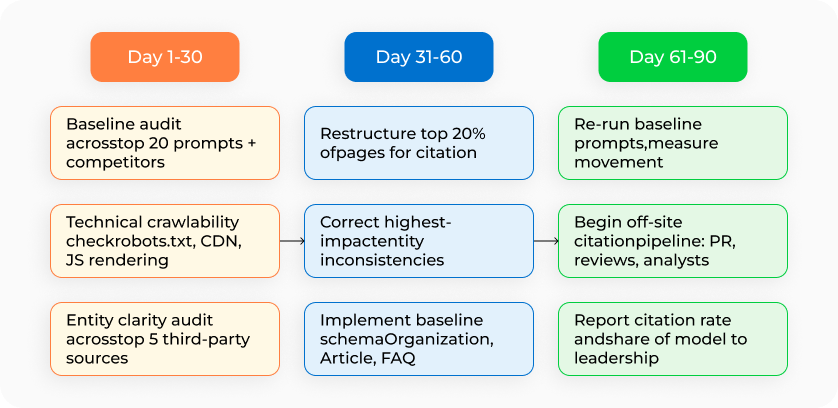
What an Enterprise AIO Roadmap Looks Like: 30/60/90 Days
- Month one (days 1-30): perform an audit of your top 20 prompts (or if that’s not feasible, 15-25 prompts that mimic buyer language) against your three nearest competitors across chatgpt, Perplexity, Gemini and google’s ai overviews. Record which prompts mention your brand name/cite links to your property/etc. Run a technical SEO crawlability test — robots.txt configuration (including CDN-based ai blocker settings), JavaScript rendering issues etc. Conduct an entity clarity audit across your five most frequently cited third-party source references.
- Month two (days 31-60): prioritize/reformat the top 20% of existing pages that will yield the greatest amount of Citation potential. Based on their existing search performance and topical relevance. Fix the most impactful entity inconsistencies noted during the previous month’s audit. Add basic schema markup (organization, article, FAQ) to the most critical pages.
- Month three (days 61-90): rerun the initial prompt set and assess movement. Commence intentional link building — through PR efforts, review platform edits, analyst relationships — as a continuous process rather than as a project.
Report Citation rates/share of model to leadership on a continuing basis alongside traditional SEO KPIs.
Frequently Asked Questions
How enterprise brands are different from small brand AIO?
The problem of scale isn’t the same as having a different problem with a different failure mode (mostly organizational constraints)
Enterprise brands have much larger content estates than small brands; nobody has visibility on which pages currently drive any citation by an ai, and those who try to evaluate legal/brand approval chains for citations were never designed to do so.
What number of prompts should i use in my enterprise AIO audit?
Begin your audit with 15-25 natural-language prompts that mirror real buyers’ phrasing when asking their ai assistant a question — not keyword style queries. Test them across chatgpt, Perplexity, Gemini, and google’s ai overviews; repeat weekly during the early stages as answers from ai models change more quickly than traditional search rankings.
Which pages should i prioritize first for ai citation by enterprise brands?
Those pages already rank well in traditional search results for high-intent queries — they’ve already proven relevance. Before creating net-new content, make the top-ranking pages for ai extractability. Almost all thin category landers, navigation pages & boilerplate/legal pages get cited very rarely because they don’t contain clean, extractable answer data.
Why does it seem like enterprise brands get ignored even though we have good content?
Almost always this is due to entity clarity issues — not content issues. Llms verify facts about an enterprise brand using third party sources (review sites, Wikipedia, press coverage, analyst reports). If these sources describe a product or service inconsistently, then there won’t be one fact that the model can confidently use for corroboration, therefore either the model will avoid mentioning the brand or reference an outdated description.

Kaushal Thakkar
Founder & CEO, Infidigit