

When i hear people talk about “AIO budget,” most CMOs initially look for the next line item to reduce spending, whether it is $500k out of an existing $2m SEO retainer, or $250k of a $1.5m search funded media budget, and therefore allocate that reduced amount towards AIO.
However, if you’re going to fund AIO using an existing SEO budget, you’ll be allocating the same dollars to perform a significantly larger job. In other words, you will either cut back on another aspect of your SEO (and thus negatively impact overall performance), or you will severely limit the potential of the AIO effort.
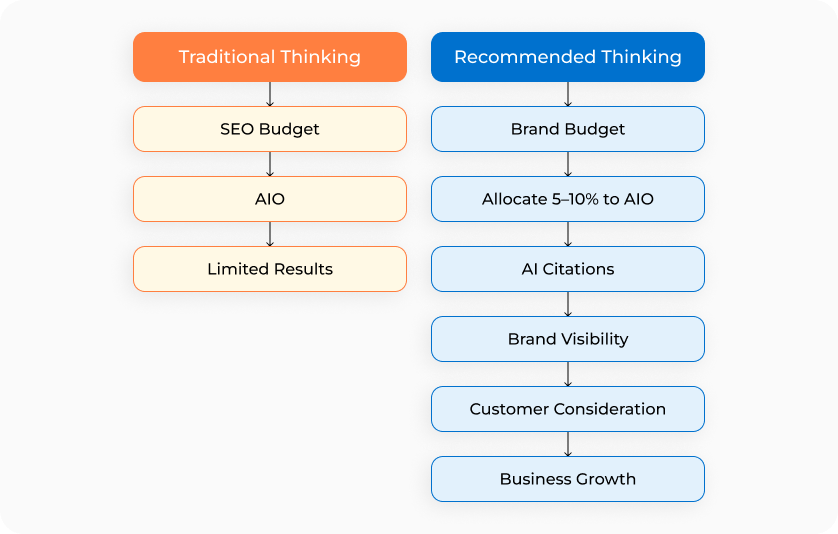
Most often, brands take a small portion of their existing SEO budget ($150k) and use it to implement some basic schema markup and create a FAQ section. If there’s no measurable citation movement in Q1, the brand assumes AIO doesn’t work for their category. Again, this assumption is incorrect. The issue isn’t that AIO doesn’t work – it’s simply that the budget sizing was inaccurate.
What tv, print & out-of-home Advertising were purchasing before AIO came along
For years, most brand marketing was focused on creating consideration, which is essentially building familiarity of a name among consumers. Consideration isn’t directly attributed to transactions. Therefore, the primary goal of nearly all tv, print & ooh Spend is the creation of awareness. Awareness is measured through less-than-perfect metrics like awareness surveys and share of voice (sov).
Now, AIO-powered discovery is accomplishing the same objective as tv/print/ooh but has two major advantages over these channels. The First advantage is that it takes place exactly during the intent phase (when someone asks a question that your brand could potentially provide an answer to) versus weeks or months prior to a consumer making a purchasing decision. The Second is that AIO-powered discovery can be tracked with better accuracy than billboards or 30-Second commercials ever could. These include citation frequency, sov against named competitors, and conversions generated from visits driven by AIO.
Therefore, if CMOs accept the idea that ai-mediated discovery is providing the same consideration-at-scale benefit as brand Advertising once provided (buying consideration at scale), then the budget discussion around AIO should follow the job, not the historical org chart. The dollars that previously went into building consideration should go to the channel building consideration most effectively today — and increasingly that channel is AIO.
Why a smaller reallocation of brand dollars will have a larger return
It would be misleading to attempt to quantify the ROI based solely on market-wide figures and apply them to your category. Those estimates are often inconsistent depending upon the source of the estimate and are easily criticized by a skeptical CFO.
Instead, i recommend developing a bottom-up model specifically tailored to your brand. Here is a simple example of a model i walk CMOs through:
Take your current brand & awareness budget as a base number. Determine what percentage of purchase research currently occurs within an ai assistant vs. Traditional search — run your own prompt-based ai visibility audit for this. Once you know that percentage, multiply your typical brand-channel conversion rates against that percentage to estimate the total addressable opportunity. Finally, determine how large a pilot reallocation you wish to pursue (typically 5% to 10% of brand budget in year one) and assign citation rates and ai-referred conversion rates as success metrics rather than attempting to project actual revenue.
Statistic: By 2030, the US B2C retail market alone could see $900 billion to $1 trillion in orchestrated revenue from agentic commerce, while global projections reach $3–5 trillion.
Primary source: McKinsey & Company, The Agentic Commerce Opportunity: How AI Agents Are Ushering in a New Era for Consumers and Merchants (Published October 17, 2025)
Supporting source: ICSC & McKinsey & Company, Shopping in the Age of AI: Redefining Stores for a New Era (Published April 2026)
How to Make This Argument to Your CFO and Board
The easiest framing for me has consistently been not “we need new money for a new trend.” Instead frame it as “we are reallocating existing brand Spend toward a more measurable channel doing the same underlying job.” Framing the conversation this way brings the conversation onto very familiar ground — budget reallocations — versus requesting additional funding, which is inherently harder to obtain than reallocate funds.
- Use job language instead of tech language: “our brand budget exists to build consideration — ai-mediated discovery is where an increasing percentage of consideration-building happens.”
- Size your pilot allocation as a % of brand Spend rather than a fixed dollar request: a 5% to 10% allocation is generally a reasonable starting point for an AIO pilot allocation. It doesn’t disrupt existing brand commitments.
- Include citation rate, share of model & ai-referred conversion rates as reporting metrics day 1 so your board can see a measurement framework rather than just blind trust.
- Schedule a specific re-evaluation point: we recommend after two quarters rather than an open-ended commitment which makes initial approval much easier.
What the Right AIO Investment Looks Like by Company Size
The CMOs are constantly asking for a number; so when they get “it depends”, they know you are telling them the truth, but the truth is no fun. The best range i can give you to avoid being too presumptuous about accuracy is:
- Mid-sized Brands with an established SEO strategy – a pilot of approximately 5-10% of your brand and awareness spend along with a focused technical/entity clarity audit will provide you a measurable signal of success in Q1.
- Large Enterprise Brands with complex content estates – the technical/governance work discussed in my article regarding large enterprises and their AIO strategies will generally take up a greater portion of your initial investment compared to your brand spend, due to the fact that both audits and remediations grow based upon the size of the content estate not the ambition of the program.
- New Brands looking to test the waters – a small time boxed pilot (a specific quarter, a specific budget, a specific prompt set to measure) is generally the best way to start building internal measurement muscle prior to allocating a larger amount of brand budget.
There is no promise with any of these ranges. These represent the patterns we’ve seen in various sizes and maturities of client engagements, and the correct number for any individual brand will always depend on category, current baseline visibility for ai, and how much of the underlying technical and entity clarity work is already in place.
Frequently Asked Questions
Should the AIO budget come from the SEO budget or the brand budget?
The brand budget. We sized SEO budgets to do a narrower job – rank on Google for a defined percentage of search volume – not fund an entirely new visibility platform. Typically if you expect the SEO budget to support AIO without increasing it, something else in the SEO program will get starved, or AIO will get a token allocation producing token results.
How much brand budget should be reallocated to AIO in year one?
A pilot in the range of 5-10% of brand and awareness spend is a defensible, low risk starting point that doesn’t disrupt your existing brand commitments.
What metrics should back an AIO budget request to the CFO or board?
Citation rate, share of model (i.e., citation frequency relative to named competitors), and ai-referred conversion — all trackable day one and give your board a framework to measure success rather than take a leap of faith.
Why does AI-powered discovery function like brand advertising?
Brand advertising has always been buying consideration – i.e. A name surfacing in memory at the moment someone starts looking for a solution. Ai powered discovery performs that same function, but at the exact moment of intent, and it’s measurable ways that a billboard or TV spot never was.
How often should the AIO budget pilot be re-evaluated?
I recommend a two-quarter check-in as the best cadence specific enough to hold the initiative accountable without requiring an open-ended commitment that makes the initial approval harder to secure.

Kaushal Thakkar
Founder & CEO, Infidigit