

As you browse through any number of marketing job boards today, there is a trend that can be identified: companies are posting for positions such as an AI Search Specialist or a GEO Lead (and/or) along side their current SEO Manager or SEO Director. There are multiple job openings and multiple job descriptions with one company and its website. I can see why it occurs. Companies are often uncomfortable with something as “new” and as unknown as Artificial Intelligence on Demand, therefore the leadership has created a brand new position instead of expanding the responsibilities of the current SEO Manager/SEO Directors role.
I am going to argue that creating a second position like an AI Search Specialist is a bad decision. This approach is too expensive, less productive and ultimately creates friction within the organization which reduces the speed at which both programs move. The reason this type of structure does not work well is not simply because of how the organization was structured. In many instances, the content that receives the highest ranking in traditional search and the content that generates citations in an AI response are, in fact, the same piece of content. Therefore, you cannot create a separation between the people who develop those types of pieces of content.
Why Keywords and Prompts Cannot Be Separated in a Single Piece of Content
Many people think of ownership at the team level when setting up two different teams. As such, many people believe that the work itself can be easily separated and defined. Unfortunately, that isn’t true.
Here is exactly what occurs. An SEO consultant takes a keyword (say ‘Enterprise Content Strategy’) and conducts an analysis on the topic to determine the subtopics, questions, etc., that need to be covered to create competitive pages. Once this information has been determined, the SEO consultant incorporates this into the content brief outlining the structure of the content.
Next, the same page is handed off to an AI Visibility Specialist. The AI Visibility Specialist identifies the prompts used by buyers searching for answers using their chat tools (ChatGPT/Perplexity) – examples include “How does an Enterprise Marketing Team structure a Content Strategy?” Next, the AI Visibility Specialist will determine that the first paragraph of each section must provide a clear, direct answer that is formatted so that an LLM (Large Language Model) may clearly reference/cite it.
Side-by-side compare both requirements. The keyword(s) drive which topics you will address, and how deep you will address them. The prompt(s) drive how you will present the information within your topical areas. Both sets of requirements affect the very same paragraphs, headings, and sentences. There is no way to write a 1500-word piece of content where some parts are specifically for the keyword, while others are specifically for the prompt. The content that answers a buyer’s question sufficiently to place well in organic search results is the exact same content that provides sufficient detail to an LLM to allow for citation.
The same writer receives two separate content briefs from two different teams; one requiring more detail in a section; additional coverage of related keyword clusters; expansion of a section; while the second requires less detail in a section; more direct language in an opening sentence; restructuring of headings into questions. The writer receives two differing instructions and creates content that partially satisfies both requirements. In doing so neither team achieves its desired outcome and the page performs poorly across both surfaces.
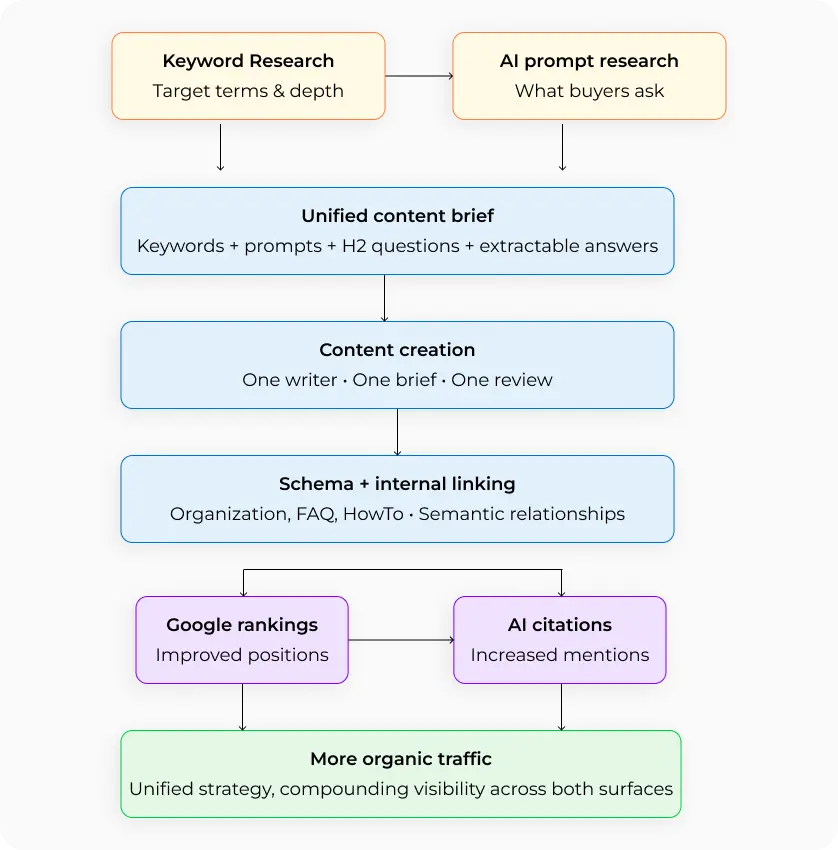
There exists a much better method. Unified ownership of content results in having just one content brief; one set of requirements; one writer; and one reviewer. The owner of the content recognizes that structuring a heading to resemble a clear question with a direct answer is beneficial for both capturing featured snippets within organic search and referencing within AI response systems. These are not mutually exclusive requirements. When viewed through the lens of a unified system; these two functions serve to reinforce one another.
The Tool Problem: Why AI Content Layering Makes Things Worse
There is another major reason why the split-team model will fail; and i think we should name it directly because it is causing damage to brands today.
A new type of tool has emerged to optimize pre-existing content for AI visibility by creating supplemental text and placing it atop of what you already have. The idea behind this is clear-cut: your content may be optimized for seo, while this tool generates AI-specific wording that makes it visible in AI generated answers. It won’t work. Moreover, it will harm the content it interacts with.
I’ll explain why. Large language models (llms) are trained to identify coherent, authoritative, human-written content. When a tool places llm-created text onto an existing human-written document, the outcome is a document containing two different types of writing styles, two different levels of detail and two different “voices” on the same page. The original content provided a consistent structure and authority signal. Adding text that provides generic information based upon patterns reduces the quality of the original.
The effects show up in two areas. First, the AI systems that were intended to reference/quote the page will quote/reference it less frequently, since the clarity/content extraction mechanisms that drive quotation/reference citations are reduced through added noise. Second and more importantly, the search engine ranking positions (serps) originally earned through quality signals of the original content begin to deteriorate due to low-quality additions degrading quality signals.
Brands that heavily utilized these tools have experienced similar results. While i am withholding brand names, the experience was consistent: stable performance initially followed by a quantifiable reduction in both organic search engine rankings and AI citation frequency over time as their content estate became increasingly filled with hybrid pages containing layered content that serves no one effectively.
The right approach to seo is the complete opposite of layering.
Instead of layering supplemental text atop of original content, the proper method begins with developing a content structure and determining what a page must include to receive rankings/citations. Then, create that structure from a single paragraph/brief. Tools such as Semrush are helpful during this development process; however, they assist by providing insight regarding what keywords are relevant, what buyer prompts are currently being used, which competitor pages are receiving citations and why. Those insights can be used to develop a brief. Once a brief exists, an seo agency or in-house team develops the content based upon that brief. The tool provides insight; the human creates content.
What Gets Broken When SEO and AIO Ownership Splits?
Even if we ignore the fact that there is no way to tell which prompt is intended by a keyword prompt, split ownership causes four significant operational failures. These failures build upon themselves as they are repeated throughout the lifecycle of your content.
The first failure is that your content briefs become contradictory. Your SEO teams’ brief will focus on getting all possible keywords covered within the content cluster and achieving maximum content depth. At the same time, your AIO teams’ brief will focus on creating content structured for conversations and providing users with easily extracted answers. Since there is no single person (or entity) responsible for combining these into a single content brief for your writers, they have to follow two separate sets of instructions at once.
The second failure is that your internal linking strategy does not provide any clear direction. Internal linking for traditional SEO distributes ranking authority from a higher authority page down to lower authority pages that require additional ranking assistance. On the other hand, internal linking focused towards AIO is used to create structural relationships between web pages based on their semantic value, so an AI can determine how all of the content across a domain relates to one another. Since the decision-making process for this issue is divided among multiple entities, the resultant internal link structure will either fail to clearly serve the goals of either function, or fail to serve them cleanly; links are added primarily for the purpose of passing equity between related content for ranking purposes but disrupt the ability of an AI to understand the structural relationship between those pieces of content. Conversely, links may be created to enhance the structural relationship between the pieces of content but add noise to the effort to pass equity between those related pieces of content for the purpose of establishing or improving their relative ranking positions.
Both of your functions also need structured data included on your most important pages. However, without unified ownership, you will likely find yourself dealing with duplicated schema blocks, where you have to deal with validation errors due to duplication, or conflicting schema implementations. For example, you may have implemented a schema block for FAQs using your SEO team’s approach and then had your AIO team implement a schema block for How-To sections. In cases like this, even though both teams targeted the same portion of the same page with their respective schema blocks, when viewed through either lens, the results are interpreted incorrectly.
Lastly, since your SEO teams report on rankings and organic traffic and your AIO teams report on citations and sessions referred to by AI systems, leadership receives two completely different views regarding how well the same website is performing. As a result of having no unified view for how changes made to one area affect others, resource allocations can never be properly planned.
The Integrated Model: What It Looks Like in Practice
The integrated model starts with one content brief template that covers both traditional ranking requirements and AI extractability requirements simultaneously. Every piece of content produced against that brief serves both audiences: the search crawler and the LLM retrieval system.
At the brief level, a unified brief specifies:
- The target keyword cluster and the topical depth required to rank competitively for it.
- The conversational prompts buyers use in AI assistants that the page should also address.
- H2 headings written as questions, because a well-formed question heading works for both featured snippet capture and LLM citation.
- A direct, standalone answer in the first two to three sentences under each H2, because that structure satisfies both Google’s NLP parsing and an LLM’s need for a clean extractable unit.
- Schema requirements covering Organization, Article, FAQ, and HowTo as applicable, with one implementation that serves both search and AI system interpretability.
- Internal link requirements with descriptive anchor texts that signal the semantic relationship, useful for both crawler navigation and LLM comprehension.
The unified brief is not longer than a standard SEO brief. It is the same length with a wider scope. The writer produces one piece of content. One reviewer approves it. One team owns the outcome.
At the team level, this means the person or team that manages traditional SEO also manages AIO. They may specialize more deeply in one area, but they hold both accountabilities. The split-ownership structure should be a transitional state at most, not a permanent operating model.
How to Evaluate Whether an Agency Can Actually Handle Both
The question to ask is not: ‘do you do AIO as well as SEO?’ Every agency will say yes. The questions that reveal whether the integration is real are more specific.
One way to test is to request a single content brief template. Ask them to show you one document that outlines requirements for both AIO and SEO. If they provide you with two separate documents labeled ‘AIO Brief’ and ‘SEO Brief’, they haven’t addressed the integration issue inside their company. In addition to the briefs, you’ll be responsible for coordinating the work.
Another method of testing is asking them how they manage pages where there’s a conflict between the keyword-driven structure and the prompt-driven structure. When determining priorities and who should make decisions, how does the agency process that? If the answers are unclear, unfluent, or without example, the agency hasn’t encountered the problem before in working with clients and therefore won’t know how to address the issue for you.
Lastly, another way to assess the level of knowledge regarding using tools to generate content vs. using tools to gain insights is through their responses. An acceptable response would include something such as: “Semrush is used to determine what prompts and keywords are applicable to each page and then our team creates the content based upon that.” On the other hand, if the response includes generating content automatically, or is too general, consider this a red flag. Automated Content Layering (ACSL), as mentioned previously, negatively impacts previous content. An agency that relies on ACSL will create negative changes in your ranking and citation rates in the long run instead of positive ones.
Finally, ask them to demonstrate a measurement report that includes both traditional organic metrics and AI citation metrics in one view. If they indicate that the reports reside in different documents owned by different individuals; the integration is being discussed rather than implemented. The measurement framework is indicative of the operational model of the organization.
The Practical Test: Before Changing Your Agency Structure
Before reorganizing your agency roster or internal team structure, run this diagnostic on your current setup.
- Pull the last content brief issued for any page on your site. Check whether it contains both keyword requirements and conversational prompt requirements in one document. If not, you are already running a split model, even if you have one agency.
- Check your robots.txt for AI crawler directives. If the SEO team manages robots.txt and the AIO program is run by a different team, there is a real chance AI crawlers are being blocked without either team realizing the other’s work depends on that access.
- Open the last schema implementation on your highest-priority page. Check whether it was informed by both ranking goals and AI citation goals. If the schema was placed by one team and the content was structured by another, the two are almost certainly not aligned.
- Ask your SEO point of contact what percentage of your cited AI Overview appearances overlap with pages that already rank in positions one through five on Google. If they cannot answer that question, citation rate is not being tracked as part of the same program as rankings. That is the split model showing up in measurement.
Each of these reveals whether the integration exists in practice or only on an org chart. Fix the brief first. The team structure will follow.
This article reflects Kaushal’s view built on patterns observed across integrated SEO and AIO engagements. No third-party statistics are cited. All claims are based on direct client delivery experience. The brand that experienced content decline from AI layering tools is not named; the pattern is described accurately.
FAQs
Should SEO and AIO be managed by one team or two?
One team. The content that ranks in traditional search and the content that gets cited in an AI response are, in most cases, the same piece of content so splitting ownership means two teams issuing conflicting briefs to the same writer for the same page.
Why can’t keyword optimization and prompt optimization be handled separately?
Because both requirements apply to the same paragraphs, the same headings, and the same sentences. There’s no version of a page where some sections are “for the keyword” and others are “for the prompt” the content that answers a user’s question well enough to rank is the same content that answers an AI system’s query well enough to be cited.
Do AI content-layering tools actually improve AI visibility?
No. Inserting AI-generated sentences into existing human-written content creates a document with inconsistent voice and specificity, which tends to reduce both AI citation likelihood and traditional search rankings rather than improve either.
What questions should you ask an agency to check if they truly integrate SEO and AIO?
Ask to see one content brief template (not two separate documents), how they resolve conflicts between keyword-driven and prompt-driven structure, how they distinguish tool-driven insight from tool-generated content, and whether their reporting combines organic and AI citation metrics in a single view.
What does a unified SEO/AIO content brief include?
Target keyword cluster and topical depth, the conversational prompts buyers use in AI assistants, H2 headings written as questions, a direct answer in the first two to three sentences under each H2, unified schema requirements, and internal link guidance with descriptive anchor text.

Kaushal Thakkar
Founder & CEO, Infidigit